
A Jellyfish Protein Won a Nobel Prize in 2008
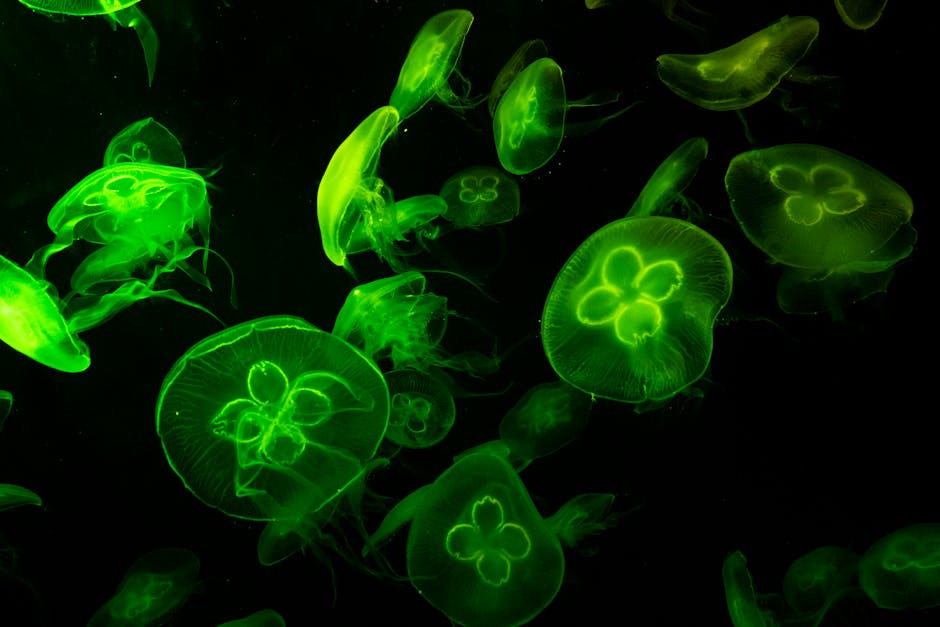
Green fluorescent protein, first isolated from the jellyfish Aequorea victoria, became a key tool for tracking molecules in living cells.
 Topic
Topic9 facts
Discover bioluminescence, the natural light show of living organisms. Explore glowing fungi, deep-sea creatures, and fireflies in this fascinating phenomenon.
Green fluorescent protein, first isolated from the jellyfish Aequorea victoria, became a key tool for tracking molecules in living cells.
Single-celled dinoflagellates flash blue when disturbed, which makes breaking waves and swimmers' movements glow at night.
In the open ocean's deep waters, bioluminescence is so common that a majority of animals are thought to produce light.
Deep-sea anglerfish carry a light-producing lure, and its glow comes from symbiotic bacteria living inside it.
The reaction is extremely efficient and produces almost no heat, which is why the light is often called cold light.
Every human body emits a faint glow of visible light produced by bioluminescent reactions in metabolic processes. A 2009 study by Japanese researchers using ultra-sensitive cameras confirmed that the human body glows with photon emission about 1,000 times weaker than what the naked eye can detect. The glow is strongest on the face, neck, and hands, and follows a daily cycle — brightest in the late afternoon and dimmest in the early morning.
When threatened, this deep-sea cephalopod releases a cloud of sticky, glowing mucus from the tips of its arms. This dazzling distraction allows the squid to escape into the dark abyss, confusing potential predators in its lightless environment.
While extremely dim, human bodies continuously emit visible light, a phenomenon called bioluminescence, though it's about 1,000 times fainter than the sensitivity of the naked eye. It's strongest in the afternoon.
Our bodies undergo continuous biochemical reactions that release photons, causing us to glow faintly. This bioluminescence is about 1,000 times weaker than what the naked eye can perceive, but it can be detected with highly sensitive cameras, revealing a hidden human glow.