
HoneybadgerTopic

Honeybadger

10 facts

Discover 10 fascinating facts about the honey badger — thick skin, venom immunity, tool use, and fearless attitude.

  • Honeybadger8 views

    Honey Badgers Are Powerful Diggers That Can Excavate Entire Dens in Minutes

    Armed with semi-retractile claws up to 40mm long, honey badgers are exceptional diggers. They can excavate a burrow large enough to disappear into within minutes, and dig out burrowing prey such as ground squirrels, lizards, and scorpions with ease. They dig over 50 burrows in a single territory, rarely sleeping in the same hole twice.

  • Honeybadger5 views

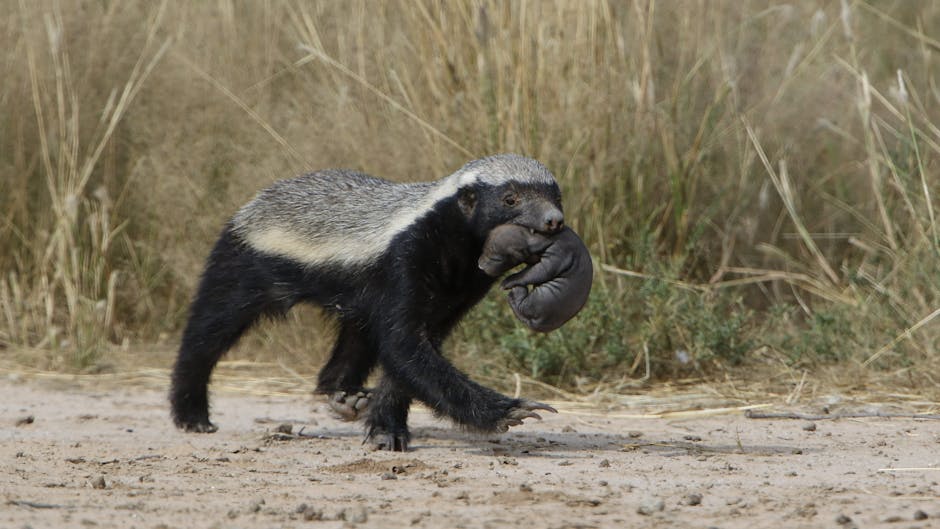
    Honey Badger Mothers Raise Cubs Entirely Alone

    Honey badgers are largely solitary animals. Females raise their cubs completely alone without any help from males. Cubs stay with their mother for 14–16 months — an unusually long period for a small carnivore — learning hunting skills and survival strategies before becoming independent. During this time, mothers relocate dens frequently to protect offspring from predators.

  • Honeybadger5 views

    Honey Badgers Have an Enormous Geographic Range

    Honey badgers are found across three continents: sub-Saharan Africa, the Middle East, and South Asia including India and Nepal. They occupy an extraordinary variety of habitats — from rainforests and savannahs to arid deserts and alpine meadows up to 4,000 meters above sea level. This adaptability makes them one of the widest-ranging carnivores on Earth.

  • Honeybadger5 views

    Honey Badgers Have a Symbiotic Relationship with the Honeyguide Bird

    The greater honeyguide bird (Indicator indicator) leads honey badgers to beehives by calling and flying ahead. The honey badger breaks open the hive, and both animals share the spoils — the bird gets wax and larvae while the honey badger gets honey. This mutualistic partnership is one of the most remarkable inter-species collaborations in nature.

  • Honeybadger5 views

    Honey Badgers Belong to the Weasel Family, Not True Badgers

    Despite their name, honey badgers are not closely related to European or American badgers. They belong to the family Mustelidae — alongside weasels, otters, wolverines, and ferrets — and are the only living member of the genus Mellivora. Their closest relatives are actually martens and wolverines.

  • Honeybadger5 views

    The Name 'Honey Badger' Comes from Raiding Beehives

    Honey badgers are notorious for breaking into beehives to eat both honey and bee larvae, which are rich in protein and fat. Their thick skin protects them from thousands of bee stings simultaneously, and their powerful claws tear apart even professionally managed hives. Beekeepers in Africa and Asia consider them serious pests.

  • Honeybadger4 views

    Honey Badgers Have Been Observed Using Tools to Escape

    Honey badgers kept in captivity have astounded keepers with their problem-solving abilities. In documented cases, they used logs, rocks, and rakes as step-stools to climb over walls, and even dismantled locks. This level of tool use and planning is rare among carnivores and reflects their high intelligence.

  • Honeybadger4 views

    Honey Badgers Are Highly Resistant to Snake Venom

    Honey badgers can survive bites from highly venomous snakes including cobras, puff adders, and black mambas. Their bodies carry a mutated form of the nicotinic acetylcholine receptor that prevents snake neurotoxins from binding effectively. After being bitten, a honey badger may collapse but typically recovers within hours.

  • Honeybadger4 views

    Honey Badgers Have Remarkably Thick, Loose Skin

    A honey badger's skin is about 6mm thick and exceptionally tough — resistant to arrows, spears, and even machete cuts. Its skin is also remarkably loose, allowing the animal to twist almost 180 degrees inside it to bite an attacker that is gripping it. This adaptation makes them nearly impossible to hold or restrain.

  • Honeybadger5 views

    Guinness World Records Names Honey Badger the Most Fearless Animal

    The honey badger (Mellivora capensis) holds the Guinness World Record for 'world's most fearless creature.' It will attack animals many times its size — lions, leopards, and even cape buffalo — without hesitation when threatened. This legendary boldness has made it a symbol of courage across many cultures.